People often ask me why a graduate in genetics and immunology ended up running an EdTech company. The question is asked kindly, sometimes with a hint of surprise, as if I had left a laboratory for a world that has nothing to do with it. In reality, I never really left the lab. I simply changed what I study.
During my years in biology, I learned a discipline more than a body of knowledge. Before concluding anything, you form a hypothesis. You design an experiment that could prove it wrong. You control the variables. You measure. Then you start again, accepting that most hypotheses do not survive their first encounter with reality. I have never found that methodical humility in a management handbook. I found it under a laminar flow hood.
An idea is only a hypothesis
In the workshops I run, from Menzel Bouzelfa to Kasserine, I meet project founders with remarkable energy. Many arrive with an idea they already love and are almost ready to defend. They have pictured the logo, sometimes the shop name, rarely the customer. That is human: an idea is a promise you make to yourself, and nobody likes to see their promises put to the test.
My first job is to take a step to the side. I don’t ask, “Is your idea good?” I ask, “What would have to be true for your idea to work?” A certain type of person must have a specific problem. That problem must cost them enough to pay for a solution. They must be able to find you, trust you and come back. Each of these statements is a hypothesis. And every hypothesis can be tested, often for almost nothing.
A business idea is not a conviction to defend. It is a hypothesis to disprove as quickly and as cheaply as possible.
The Business Model Canvas as a protocol
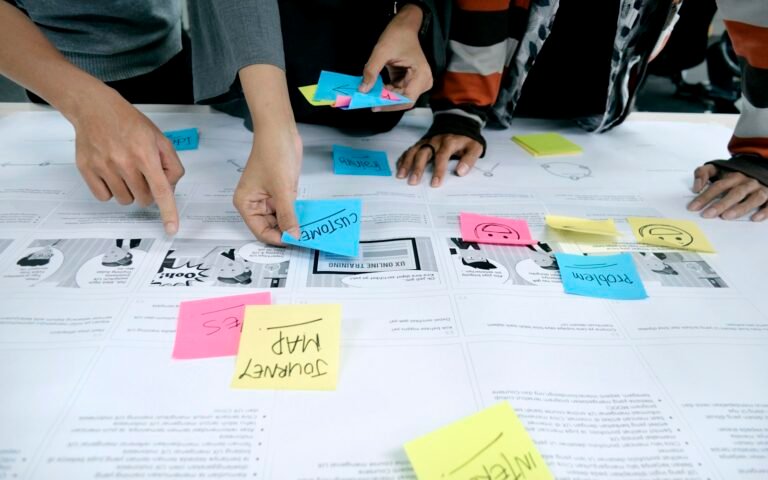
The Business Model Canvas has become such a familiar tool that we forget how powerful it is. It is often filled in like an administrative form: nine boxes, nine answers, and on to the next thing. I prefer to present it as an experimental protocol. Each box contains a hypothesis, and some hypotheses carry the whole weight of the project.
Take a common example. A young woman wants to sell local produce from her region online. On paper, everything holds up. But looking more closely at the canvas, one box concentrates the risk: the channel. Her potential customers live in Tunis or abroad, her products are fragile, delivery is expensive. Until that hypothesis is verified, working on the logo is like painting the front of a house whose foundations have not yet been poured.
So we design an experiment. A simple page, a WhatsApp catalogue, twenty contacts approached, three test shipments. Within two weeks, we know whether the channel holds. It is less glamorous than a launch, but infinitely more useful.
Measure, even when it is uncomfortable
Science also taught me to love inconvenient numbers. In an experiment, a negative result is still a result. It tells you something. In business, we tend to look at the numbers that flatter us: likes, views, compliments from friends and family. Those are vanity metrics. They warm you up, but they don’t shed any light.
I push the entrepreneurs I work with to choose one or two indicators that really matter, and to look at them every week. How many people asked for a price? How many bought? How many came back? These numbers are often modest at first. They have the merit of being honest. And honesty, in business as in the lab, is the condition for progress.
Rigour does not kill intuition
We sometimes imagine the scientific method as the enemy of creativity. That is a misunderstanding. Great discoveries begin with an intuition, a question nobody had thought to ask. Method does not extinguish intuition; it keeps it from getting lost. It turns a good idea into a verified idea.
That is what I try to pass on, whether in an in-person workshop or in an online course on GenAlpha: keep the boldness of the idea, and give it the discipline of proof. Between the two lies the space where projects become solid.
What I take away
If I had to sum up what genetics taught me about entrepreneurship, I would say three things. First, everything you think you know about your market is provisional. Second, the best test is the one that costs the least and answers the fastest. Finally, you should celebrate disproven hypotheses, because they saved you months of work in the wrong direction.
I never left science. I simply discovered that the market is the largest laboratory of all, and that every entrepreneur is running their own experiment there, whether they know it or not. You might as well run it with method.
Frequently asked questions
How do you apply the scientific method to a business project?
Treat the idea as a hypothesis, identify what must be true for it to work, then test those conditions as quickly and cheaply as possible.
Which metrics should you track at the start?
One or two numbers that really matter, such as price requests, purchases and returning customers, rather than likes or views.
Want to apply this to your project?
Réservez un appel découverte gratuit de 20 minutes.